Sunday, August 20, 2023

Bob Brinker Closing Marketimer Newsletter

 Here is a copy of an email forwarded by a friend and subscriber to my newsletter. 

A friend forwarded this to me, thought you might be interested.  I know you’re no fanboy, but still, goes way back.

Received this in today's mail:

"Due to personal reasons, the Marketimer Investment Letter is closing.  The June 2023 edition was our final issue.

Enclosed is a refund for the remaining balance of your subscription.

Thank you for your support over the last four decades."

Hopefully Bob is well and wants to spend his twilight years with his family in full retirement. 

After missing yet another bear market last year leading to 15-years of underperformance, he may not have had enough subscribers to pay the bills for a newsletter that came in the mail.


If you are looking for a "more modern" newsletter that covers stocks, ETFs, fixed income and Bonds, then give Kirk Lindstrom's Investment Letter a try. 


To see what stocks, ETFs and fixed income investments are in my "Explore Portfolio" and get a full list of on my price targets to take profits or buy more:
 Subscribe NOW  and get
the
 August 023 
Issue for FREE!!! 
(If you mention this ad)
More about Series I Bonds


Thursday, November 02, 2017

New I-Bond Rate is 2.58%

The Current I Bond Composite Earnings Rate is 2.58% and the Top Rate for older i Bonds is 6.12%!  For a complete listing of rates, See Rates for Older Series I Bonds.

Yesterday the Bureau of the Public Debt announced earnings rates for Series I Savings Bonds and Series EE Savings Bonds, issued from November 1, 2017 through April 30, 2018.

Series I bond, or iBond, fixed rates are determined each May 1 and November 1. Each fixed rate applies to all I-bonds issued in the six months following the rate determination.
===================
===================
For more about how I Bond Rates are calculated and the new rates for older iBonds, see:
Disclosure: I own Series I Bonds in my personal account ()  I also currently have them in my Newsletter Explore Portfolio.  Some of the old iBonds in my personal account have base rates of 3.0%! Subscribe now and see if I recommend these new I-Bonds for purchase or something better for the fixed income part of your investment portfolio.
Source: Fiscal Service Announces New Savings Bonds Rates, Series I to Earn 2.58%, Series EE to Earn 0.10%

Wednesday, January 13, 2016

Oil Price Discussion - Severin Borenstein & Tom Vacar

On Sunday January 9, 2016, Bob Brinker took a holiday and KTVU reporter Tom Vacar was the guest host.

More about Tom Vacar

I posted links where you can listen to the show at

In the first hour, Tom had a fascinating interview with Severin Borenstein from UC Berkeley - The Energy Institute at Haas (Haas is the Haas School of Business where people get their MBA at UC).

Severin Borenstein explained why the Saudi's probably have not cut production and why there is good reason to believe low oil prices will be around for some time to come.

If you own mutual funds and stocks for dividends, especially any related to energy, then I suggest listening to this discussion while asking yourself "how safe are my dividends?"

Kirk Lindstrom's Investment Letter  

Subscribe NOW and get the January 2016 Issue for FREE!!!


Friday, November 06, 2015

Originally posted on Bob Brinker Fan Club Blog on Oct 28, 2015 as:

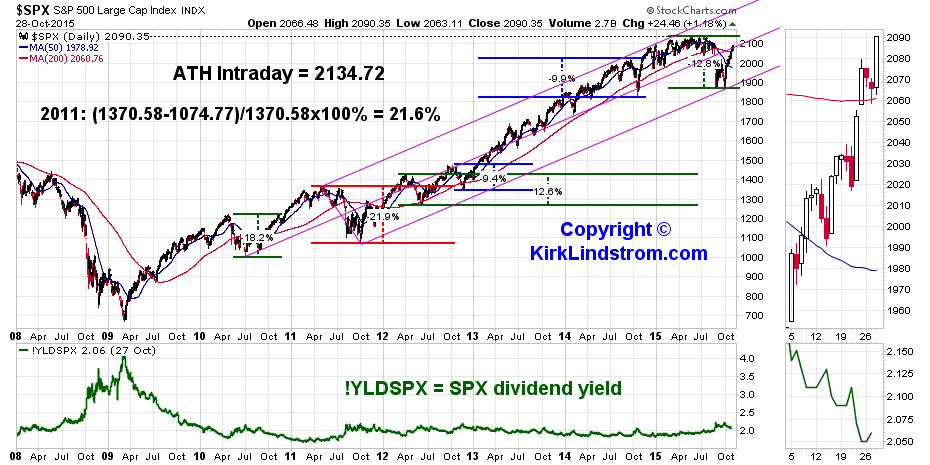
Today the S&P500 recovered all the losses made since it crashed below its 200 day moving average in August. 
 Note the next graphic shows a test of the low to make a "W bottom" followed by a near perfect test from above of the tip "^" of the "W" between the two lows.  


The final image shows how far below the peaks the markets were during at the closing low just over two months ago.

Hopefully you all joined me in:

  1. Significant Profit taking before the August crash
  2. Significant buying while making and testing the lows
  3. Taking some very nice profits NOW that we've recovered.


The final image shows how far below the peaks the markets were during at the closing low just over two months ago.

See:
Kirk Lindstrom's Investment Letter  
Subscribe NOW 
and get the 
October 2015 Issue for FREE!

Monday, February 25, 2013

Moneytalk with Bob Brinker Show Report

Items Covered
  • New Bull Market Highs
  • Affect of High Inflation on Stock Market
  • Brinker's Stock Market Outlook
  • Sequestration
  • New Taxes to Avoid Sequestration
Moneytalk with Bob Brinker Commentary for February 24, 2013 Radio Show

New Bull Market Highs

Bob Brinker did not talk about the stock market hitting a new bull market high this weekend.  Bob went right into a discussion of the sequestration and ways to raise taxes such as taxing the $16,000 paid by employers for the average families health care.    I find that rather odd as some of us are very happy our portfolios are at record all-time highs!  

I wrote an article for Seeking Alpha about the new highs on Friday.  You can read it at:
Here is a chart showing SPY, the exchange traded fund for the S&P 500, making a new record high last week after including dividends paid.


Affect of High Inflation on Stock Market

A caller asked Brinker what affect high "runaway" inflation would have on the stock market.  Brinker said this would be the worst case thing for stocks which is why you want a system that prevents this.  He then talked about how the Federal Reserve has a dual mandate from congress for stable inflation and maximum employment.

Read more about this at the Chicago Fed's web site The Federal Reserve's Dual Mandate
"The Board of Governors of the Federal Reserve System and the Federal Open Market Committee shall maintain long run growth of the monetary and credit aggregates commensurate with the economy's long run potential to increase production, so as to promote effectively the goals of maximum employment, stable prices and moderate long-term interest rates."


Make sure you read: Terry Savage: Fed Destroys Retirement Plans

Brinker's Stock Market Outlook

Kirk Here: Bob Brinker has been "Fully invested" in the stock market since March 2003.  His "balanced" model portfolio three is currently about two thirds in equities and one third in fixed income.  The other two model portfolios are 100% in equities.  My opinion, he takes excessive risk with these portfolios because if the market crashes, like it did in 2008 with him very bullish, he can screen calls and advertise his fixed income advisor newsletter.  For more, read:
Moneytalk with Bob Brinker Commentary for February 17, 2013 Radio Show
The following commentary is from my "Retirement Advisor" writing partner,  David Korn. 

STOCK MARKET

Brinker Comment:
  The stock market indexes are all at or close to their 2013 year-to-date highs and for the most part the highest levels in several years. Those indexes have been strong year-to-date.  Having said that, there is a lot of bullish sentiment.   A lot of the indicators are showing a lot of bullishness.  Usually, at some point, that kind of over-zealous participation is very frequently cause for profit taking.  So if you see some profit taking coming into the market, you should not be surprised given the high level of sentiment in a number of indicators.

EC: It is relatively rare for Bob to make these kinds of clear cautionary remarks.  His comments about sentiment mirror the focus of the e-mail I sent to subscribers one week ago tonight.  He and I are on the same page on this issue.


SEQUESTTRATION


Brinker Comment:  The big story this weekend is the sequestration that takes place on March 1, 2013.  That is when the automatic spending cuts take place.  This is basically an $85 billion mandatory spending cut program agreed to in the summer of 2011.  The President this weekend is announcing that he has an idea to reduce the deficit by $1.5 trillion over 10-years, which is a significant amount of money even though our deficit is high.  He wants to speak with the House to get this done.  On one side, people say they don’t want to cut spending by $85 billion because that will hurt the economy, whereas others say that’s a drop in the bucket and if you can’t handle this kind of cut, what can you handle?

If you can get the annual deficit down to 3% or less of GDP (total goods and services) you can probably grow your way out of the problem.  Our country was at a point where our annual deficits were 10% of GDP but now we are down to 6% which is a major step forward but is still way to high.  We have $16.5 trillion in debt and the only reason we are getting a pass on it right now is because interest rates are near zero, but we have to pay the interest on that.

EC:  Read “Obama chief of staff warns of sequester” at the following url: http://tinyurl.com/beyqxep

New Taxes to Avoid Sequestration


Brinker Comment:  The President is talking about tax increases with the wealthy the target.  They got hit with the 2013 increases, the affordable care act and now the “balanced approach” discussed by the President with five areas at risk for tax increases which can include reductions in tax deductions.  Bob said we are not going to be talking about marginal rate increases because that battle was fought in December.  But reductions in deductions are on the table.  Bob discussed the various potential areas for increasing tax revenue.

Mortgage Interest Deduction. One of the things that is inherent in changing the mortgage interest deduction is taking the money out of the pocket of high earners and the way you can do that is eliminating part of the mortgage interest deduction some high earners tend to have large mortgages (if they have one). Right now, there is a cap on mortgage interest for mortgages over $1 million.  They could reduce that cap as it is currently a high level which is a gift to high earners.  If they reduced that they would raise tax revenue.  Another mortgage-related deduction on the table is the second home deduction which is very valuable for high earners who have a vacation home.  And finally, there could be a “means test” used to determine whether you make too much in earnings to allow you to take the full mortgage deduction.

Deduction for State and Local Taxes.  Right now you can deduct your real estate taxes, your sales taxes, etc. for those who itemize.  The last year we have numbers for this is 2010 and taxpayers deducted $260 billion in state and local taxes.  If you took 20% of that, you would increase revenue by $52 billion a year.  Once again, this would be skewed to high earners.  The camel’s nose on this one is already under the tent because they have already eliminated the state and local tax deductibility for victims of the alternative minimum tax.  So keep an eye on this one.

Charitable Deductions.  The President has already proposed a cap on the deductions to charity.  They could easily set an income threshold like they do for medical expense deductions.

Employee-Sponsored Health Care Benefits:  There are 150 million beneficiaries of this.  If you work for a company that pays for all of your health care, you get that benefit without being required to pay taxes on that benefit.  If your neighbor pays his own premium, he doesn’t get a tax break on it.  The average premium per family is $16,000.  If they made that taxable, that would be a tremendous amount of money.  The joint committee on taxation estimates this is $150 billion annual revenue!

Municipal Income Tax:  Right now, municipalities are benefiting from near zero rates.  They could cap the amount of income you can earn tax free.

Bob said the overriding theme in all of the ways the government wants to bring in revenue is to go after the high earner.

EC: Republican Senator John Barrasso said today that the country should be prepared for sequester because it is going to happen on March 1st.  Read more here: http://tinyurl.com/a2pv6kt


Check out these portfolios at record highs:


Kirk Comment:  Read: Best Retirement Portfolio For You

Tuesday, February 12, 2013

Terry Savage: Fed Destroys Retirement Plans


I got this great summary in an email from Terry Savage that I want to pass on to my readers.

Savage Truth:  The Fed is Destroying Retirement Plans!

The Federal Reserve is trying to save the economy – but it is killing retirees’ financial plans.  This prolonged period of low interest rates has been devastating to those who planned to live on their interest income.  And for those approaching retirement, it means you may need much more money to afford retirement.

Chicago-based Morningstar, the largest provider of 401(k) managed accounts with more than 800,000 participants, has just announced it is changing its retirement modeling program because of the Fed’s actions.   And whether you’re just in the “saving for retirement” stage or the “withdrawal planning” stage – or in the midst of actually trying to live on your savings – you might want to reconsider your plans, too!

Taking Money Out

How much can you withdraw from your retirement accounts every year and not run out of money before you run out of time?  That’s the overwhelming question facing every retiree – and those planning to retire. 

The whole question is made far more difficult by the low interest rate environment of the past few years.  While the Fed pushes rates down to try to get the economy going, those who planned to live on their interest earnings are devastated.

Real interest rates are actually negative when you take into account the impact of inflation.  And inflation for seniors -- which is heavily weighted toward medical care, and property taxes, and food and energy bills – is even greater than the inflation numbers measured by the traditional Consumer Price Index (CPI).  It’s fair to say that for seniors, savings invested conservatively in 10-year Treasuries is producing a real loss of buying power each year.

And that is the real issue here:  How much can you withdraw every month, or year, to keep your standard of living? And if low rates force you to withdraw more, how much sooner will you run out of money?

The Traditional Rule

Financial planners have sophisticated computer models to tell you how to diversify your investments – and how much you can withdraw on a regular basis.  The process is called Monte Carlo modeling.  It takes into account historical returns of investments, such as stocks and bonds.  
Monte Carlo goes beyond using an average return for investments.  That would be dangerous, because averages mask great extremes.  Instead this computerized modeling takes into account the small, but existing possibility of extreme movements in markets.  That’s the kind of action we’ve seen in the past decade in the stock market.

The simple rule derived from this kind of modeling has always said that with a well-balanced investment portfolio that contains both stocks and bonds:  You can withdraw 4 percent a year from your principal and have a 90 percent probability that you won’t outlive your money.
Since Monte Carlo modeling takes into account the potential of wide swings in the stock market, retirees and their planners have felt confident in using this rule to plan their retirement investments and withdrawals – even during recent wild swings in the stock market.  Those kinds of stock movements have happened before.  And as we’ve seen, the market ultimately returns to its norms.

You could live with volatility in stocks as part of your portfolio – because you were getting a steady return from your conservative bonds.  But what happens when bond yields go to extremes – as they have today – extreme lows?  What happens when bonds are not yielding anywhere near their historic models, and the low yields persist over a period of years?
The impact could be devastating on a retiree’s withdrawal strategy – causing him or her to run out of money far more quickly than expected. 

That’s the scientific explanation of the anxiety that seniors are facing today.

Changing the Model

Now the experts are considering changing their models to adjust for this unprecedented and prolonged Fed intervention in the bond market.   Morningstar says that a 4 percent withdrawal rate from a balanced portfolio, once considered a secure way to plan, could now lead to a 50/50 possibility of running out of money too soon.

Instead David Blanchett, head of retirement research for Morningstar’s Investment Management division,  suggests that a retiree who wants a high degree of certainty over not outlasting his or her money should reduce the withdrawal rate from 4 percent a year to only 2.8 percent annually.   And to get the same amount of money to withdraw each year, that means you would need 43 percent more savings before retirement!

Blanchett is not alone in his findings.  Well known financial planner Joe Tomlinson has just published a sophisticated research paper in Advisor Perspectives, Inc., suggesting that  the immediate impact of current low bond yields will crush most retirement withdrawal plans.  He notes that most planning software includes an average historical real (after-inflation) return of 2.4 percent for intermediate term government bonds.  But the current real return, as measured by yields on Treasury Inflation Protected Securities (TIPS) is a negative - 0.73 percent.  The impact of wrong assumptions exponentially impacts the likelihood of the plan’s success.  [http://advisorperspectives.com/newsletters13/Predicting_Asset_Class_Returns-Recommendations_for_Financial_Planners.php]

What to Do Now

No matter what your stage of retirement planning – or retirement living, this is the time to re-think your numbers.  If the Fed keeps rates low even for another few years, you have to think about working longer, saving more, earning some extra money in retirement, or living on less.
What you should NOT do is take on more risk!  Trying to get higher yields on the bond portion of your investments by purchasing riskier bonds, or locking your money up for longer time periods, could be even more devastating when the Fed loses control – and all the money the Fed has already created produces inflation, which will bring higher rates.

Yes, these are tough times.  And according to the financial models, times will get even tougher for retirees living on fixed incomes.  It’s time for AARP to take the Fed to task for its low-rate policies.  And that’s The Savage Truth.


Sunday, December 31, 2006

Welcome Message

Welcome to the Bob Brinker Fan Club


Brinker is a former stockbroker who has more than 25 years of investment management experience. He got his first taste of the radio business in the 1960s. While a student at Temple University, Brinker took a dual major in radio and television communications and finance. He later hosted a nightly rock 'n' roll radio show in Santa Fe, N.M. He began doing a financial talk program in 1981 and took the show national on Super Bowl Sunday 1986.
--Daily Press, November 8, 2000


Site Meter

Tuesday, October 19, 2004

Asia Market Watch Appearance: Oct. 19, 2004


To get Bob Brinker summaries like this delivered to your email box, send a request to TalkAboutMoney@gmail.com.
Bob Brinker appeared on CNBC Asia Market Watch on Monday October 19, 2004. Below is a quick summary of what he said.
INFLATION
Bob was asked about the inflation numbers that came out today. Bob said he thinks the Federal Open Market Committee will have a lot of smiles when they meet next month in Washington. The CPI year-over-year rate is 2.5% and the core rate is only 2.0%. When you dissect the CPI, other than energy, the main culprit is medical expenses. All in all, however, the CPI remains tame.
Bob predicted that the FOMC would raise the Federal Funds rate by 25 basis points at the next meeting because they want to get rate up to 2.0% to give them a cushion to lower rates in the event they need to. If there is anything that can slow down the Fed's "measured pace" its the price of oil which they will be watching closely -- especially at the December meeting.
EC (Editor Comment): You can read the CPI report at this link:
http://stats.bls.gov/news.release/cpi.toc.htm
TERROR RISK PREMIUM
Bob was then asked whether the "terror risk premium" built into the market was going to dissipate by election. Bob said investors are looking forward to November 2nd which is only a couple of weeks away. Once the election passes, the incentive for a terrorist strike to impact the election process goes away.
EC: That question must have been either scripted by Bob, or perhaps Bob got that idea off CNBC Asia. It is pretty much verbatim to what Bob discussed on Sunday's show as set forth in my October 18-19, 2004 newsletter. (E-mail me if you didn't receive it)

VALUATION

The interviewer then pointed out that despite some good corporate earnings being reported, the market didn't seem to be responding favorably presumably due to the election and the price of oil.
Question: How does this impact the market's valuation?
Answer: Bob said he is very comfortable with his Marketimer estimate of $68 for next year's earnings for the S&P 500. With the market's current price, that gives the market a price-to-earnings ratio of about 16.2 which in Bob's opinion is a very reasonable valuation metric.
EC: This jives with the interpretation of Bob Brinker's timing model that SteveT and I did a few newsletters back. With the S&P 500 closing today at 1103, it is just a few points away from Bob's most recent "buy signal" of 1100 in the S&P 500.
That was about it for the interview.
To get a FREE COPY of this interpretation of Bob Brinker’s Timing model and to learn how to get summaries like the above of what Bob Brinker says on TV and radio delivered to your email box, send a request to TalkAboutMoney@gmail.com.

DISCLAIMER: I am not associated with ABC Radio Networks, Moneytalk, Bob Brinker, or CBNC Asia Market Watch. The information contained in this bulletin is not intended to constitute financial advice and is not a recommendation or solicitation to buy, sell or hold any security.